Tree Service Leads: Where They Come From and What They Cost
Search that phrase and page one is mostly people selling leads, plus a Reddit thread and a Facebook group where owners ask each other what works. The threads are the honest part of that page, and the question in both is the one you probably typed it with: what does each way of getting work actually cost.
We sell tree service marketing, so read the rest with that in mind. What follows comes out of accounts we pay for, and where we have no number we say so instead of borrowing one.
The four places the work comes from
Everything an owner calls a lead arrives through one of four doors.
Someone else finds the homeowner and sells you the contact. An ad you paid for gets clicked. A homeowner searches, finds your listing or your site, and calls. A past customer calls again, or tells a neighbour to.
The four differ on one axis that matters more than price: whether you keep anything when you stop paying. Bought leads and ads stop the day the card stops. Search presence and reputation carry forward. That is the whole argument for doing both at once rather than picking a side.
What we can price, and what nobody publishes
We can price two of the four, because we run them.
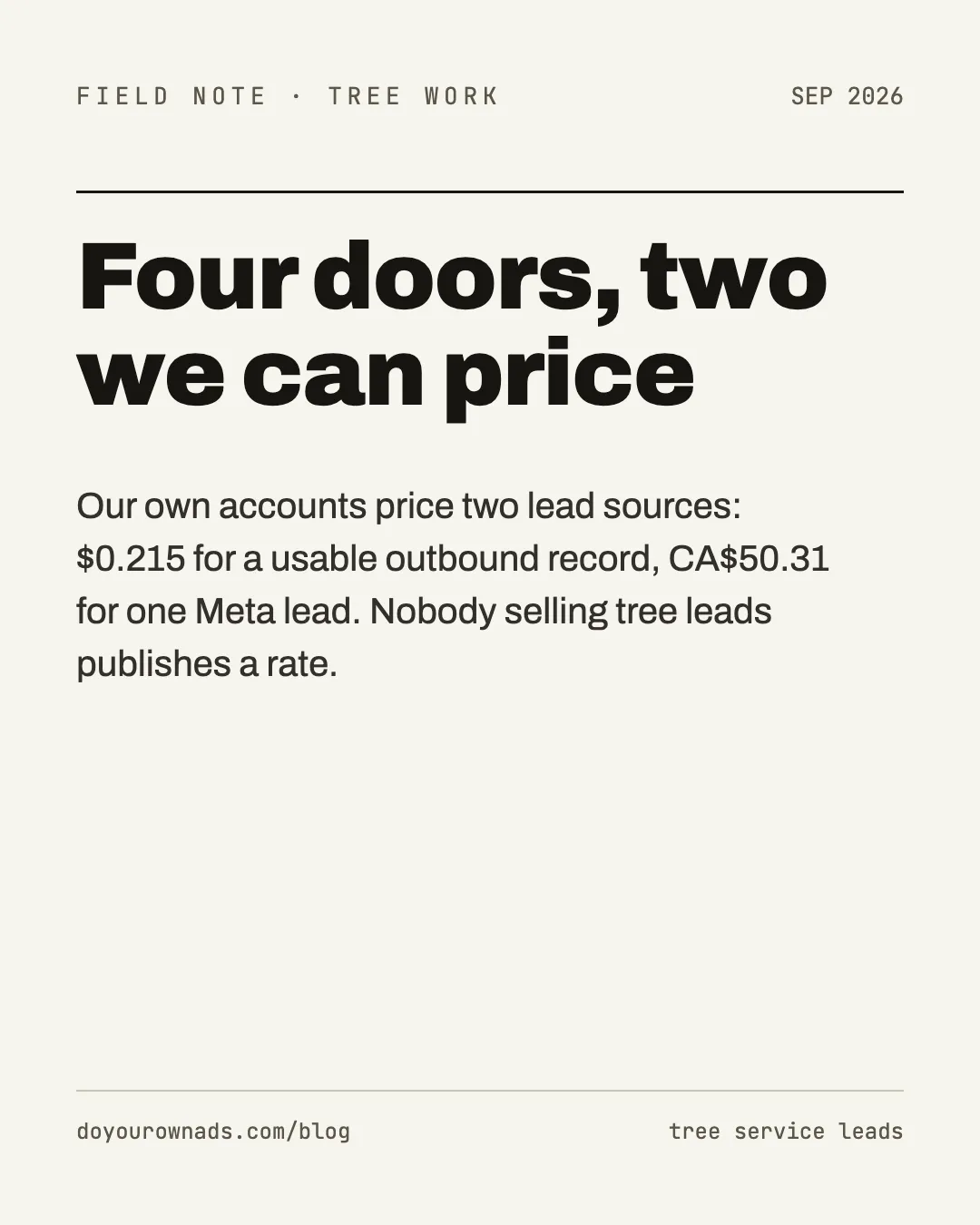
Building an outbound list yourself is the cheapest thing on this page and the slowest to pay off. On a 100-listing pilot billed to our own Apify account on 2026-08-17, scraping Google Maps cost $5.01 per thousand listings and skip-tracing cost $0.0552 per lead. After dropping the matches that were not usable, one owner name with a working domain cost $0.215, which is the number you would pay too. That is a real number and it is also a misleading one on its own, because 0% of tree service listings in that pilot exposed an email address, so the cheap part of the pipe feeds an expensive part.
Paid social is the other one we can price, and if you have been told it is cheap, our number is worse than the plan we wrote assumed. Between 2026-09-18 and 2026-09-20 our own Meta account spent CA$98.65 and produced one confirmed human lead at CA$50.31, about US$36.72. CPM over that window was CA$77.64. The plan behind the campaign had assumed CA$15.
The two we cannot price are the two you are most likely asking about. Google's Local Services Ads charge per lead and the rate moves by trade and metro, and Google does not publish a figure we could point you at. Neither do the lead vendors ranking for this search. One of them, 99calls, shows $33.99 in its own listing title, which is that company's marketing about its own product rather than a market rate, so treat it as a claim to test on a call rather than a price.
If a comparison anywhere quotes you a confident cost per tree service lead across vendors, ask where the figure came from. We looked, and it is not on their pages.
The number that settles the argument
Cost per lead is the wrong thing to compare, and it is the thing every vendor will quote you. Compare cost per booked job instead.
Take fifty leads from any source, count how many turned into signed work for you, and divide the spend by that count. A source that books one lead in ten makes every signed job carry ten times the lead price. A source that books one in three carries three. Which means a lead priced three times higher than another can still produce the cheaper job, and usually the expensive one is expensive because somebody qualified it first.
Most owners do not have that number, because nobody writes down where the call came from, and you will not be an exception unless somebody starts. Fixing that costs nothing and changes which channel you defend in a slow month. Our missed call cost calculator exists for the same reason: it turns a vague sense that calls are slipping into a figure you can compare against a lead invoice.
Where the money leaks after the click
The expensive failure is usually not the ad you wrote. It is what happens after the click.
We measured this on our own account in September, and it is the leak you are most likely to have without knowing. One ad set bought ten link clicks and recorded three landing page views. Seventy percent of what we paid for never reached the page it was paying to reach, on an ad with a 3.70% click rate. The creative was working. The destination was losing the traffic.
The phone version of the same leak is larger and older. A homeowner with a cracked limb calls three companies and hires whoever answers. If your crew is up a tree, that is nobody. We wrote about the arithmetic of that in what missed calls cost a tree service, and it is the reason tree service answering and speed to lead is the first thing we fix for an owner who thinks he has a lead problem.
What to do first, in order
Count your booked jobs by source for one month. It is the only step here that costs nothing and it changes every decision after it.
Answer or text back every call inside five minutes, including the ones that come in while you are working. Then, and only then, put money into a channel.
If you already run Google Ads and the leads are not closing, the account is usually the problem before the budget is, and a Google Ads account audit will tell you which. If you have never run ads and want the whole channel built and managed rather than learned, that is what our done for you tree service marketing is.
Two posts worth reading next, because they cover the parts this one skims: scaling past one truck on what changes when lead volume stops being the constraint, and how to get tree service customers on the channels that keep working after you stop paying.
FAQ
How much do tree service leads cost? It depends on the source, and nobody in the category will give you a straight answer up front. We can tell you what two sources cost us: $0.215 for a usable owner record from an outbound list build on 2026-08-17, and CA$50.31 for one confirmed lead from Meta ads between 2026-09-18 and 2026-09-20. Local Services Ads and shared lead vendors do not publish rates.
Are bought tree service leads worth it? For a defined stretch, often yes. A new crew, a slow month, a new territory. As a permanent channel they work badly, because you are renting demand at a price somebody else sets, and nothing you rent accumulates for you.
What is the cheapest source of tree service leads? By cost per lead, it is an outbound list you build yourself. By cost per booked job, usually repeat customers and referrals, which cost nothing to acquire and close at rates no cold channel matches. Cheapest per lead and cheapest per job are rarely the same channel.
How do I know which source is working? Ask every caller how they found you and write it down against the job, not against the call. Sources that look strong on call volume often look weak on signed work, and you cannot see that without the second column.
Should I run Google Ads or buy leads first? If you can answer the phone reliably, run your own ads, because you keep the account, the data and the search history. If you cannot answer reliably yet, neither one will pay, and the first fix is coverage on the phone.