Scaling a One-Truck Tree Service Into a Two-Crew Operation
The second truck is the point where a tree service stops being a job you do and starts being a business you run. Plenty of owners buy the truck first and find out afterwards that the constraint was never equipment. It was the hours in the week that only they could cover.
This is a look at what has to be true before a one-truck operation carries a second crew, and how to tell whether you are there yet.
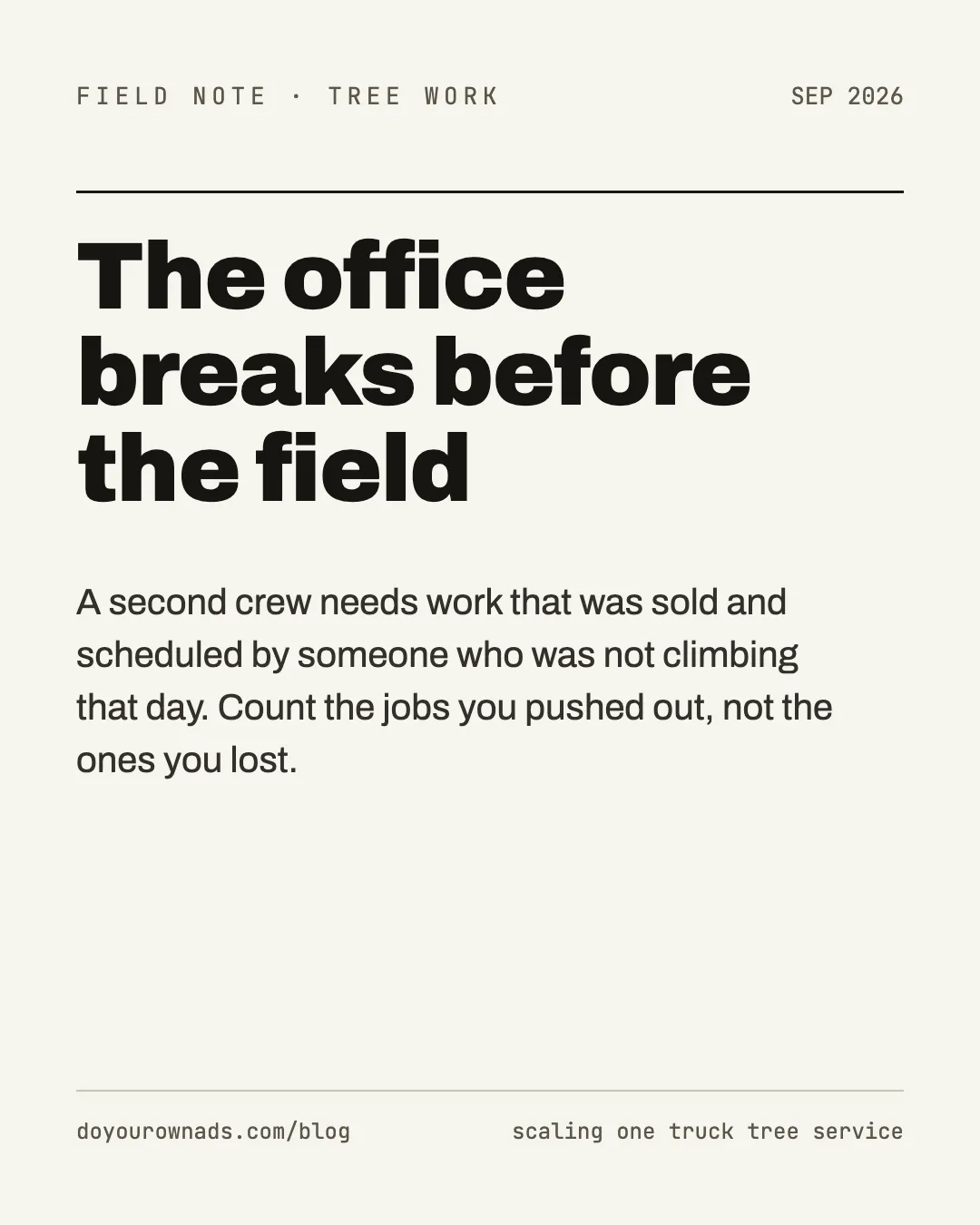
The office breaks before the field does
A single crew works because the owner is the whole back office. You quote from the seat of the truck, you answer the phone between cuts, you invoice at night. That arrangement holds at one crew and falls apart at two, because the second crew does not just need work. It needs work that was sold, scheduled, permitted and sequenced by somebody who was not climbing that day.
The failure shows up as a crew standing in a driveway at nine in the morning with nobody to ask about the neighbour's fence. Every hour of that is payroll against no revenue, and it comes out of the same week you added the truck to grow.
So the first question is not whether you can afford another climber. It is whether the selling and scheduling work can survive you being unavailable for a full day.
Three things that have to exist before the second truck
**A pipeline that does not depend on you selling every day.** One crew can be fed by referrals and whatever comes in while you are on site. Two crews cannot, because the volume you need doubles while the time you have to chase it stays the same. This is where a steady paid channel earns its keep, and it is the reason our done-for-you tree service lead generation work exists at all. If you already run ads and they are not producing, the problem is usually in the account rather than the budget, which is what a Google Ads account audit is for.
**A phone that gets answered when both crews are in the air.** At one crew you can call people back at lunch. At two, the callbacks pile up behind two job sites, and a homeowner with a leaning limb does not wait. Work out what your own missed calls are worth before you decide whether this matters, using the missed call cost calculator. It takes your job value and your own missed-lead count rather than an industry average.
**Prices that carry two payrolls.** A rate that leaves you a living at one crew can leave you underwater at two, because the overhead you were absorbing for free stops being free the moment you are not on the saw. If you have never rebuilt your numbers from the ground up, how to price tree removal jobs without guessing walks through the method rather than the number.
Measure the demand before you buy the capacity
The honest test is boring and it takes about a month. Count the jobs you turned down or pushed out more than two weeks, week by week, and write down the quoted value of each one. Not the ones you lost on price. The ones you could not fit.
If that column is thin, a second crew will spend its first season looking for work, and you will have bought yourself a fixed cost to chase a variable problem. If the column is consistently full, you already have a second crew's revenue sitting in your rejected pile and the only thing missing is the crew.
Here is the arithmetic, using our own assumptions rather than a borrowed benchmark. Suppose a second crew costs you a fixed amount each week in wages, insurance and payments, and suppose your average job clears a known margin after materials and disposal. Divide the weekly fixed cost by the per-job margin and you get the number of extra jobs a week the crew has to book before it pays for itself. Put your own two figures in. The point of the exercise is not the answer, it is that most owners have never written the two figures next to each other.
Hire the order, not the person
The instinct is to hire another climber, because climbing is the visible work. In practice the first hire that buys back an owner's week is often the one who takes the phone, the quotes and the schedule, because that is the work that cannot be done from a bucket.
There is a reasonable argument the other way when the owner genuinely prefers the office and has a foreman ready to run a truck. The test is which half of the job you are the bottleneck in. Whichever half that is, hire it.
Year one habits that do not scale
Several of the things that made the first crew profitable quietly stop working at two, and they are worth naming: quoting from memory, invoicing weekly instead of on completion, and keeping the schedule in your head. Each one is survivable alone and none of them survives being doubled. The same pattern shows up in what tree service owners learn in year one, where the habits that got the business started are the ones that cap it.
FAQ
How do I know if I am ready for a second tree crew? Track the jobs you turned down or pushed out more than two weeks for a full month, with the quoted value of each. If that list is consistently full, the demand is already there. If it is thin, the second crew will be looking for work rather than doing it.
Should I hire a climber or an office person first? Hire the half of the job you are the bottleneck in. For most owner-operators that is the selling and scheduling, because it is the work that cannot be done from the bucket and it is the work that stops when you climb.
Do I need to raise prices before adding a crew? You need to rebuild them. Overhead you absorbed for free while you were on the saw becomes a real cost the moment you are not, so a rate that worked at one crew is not automatically a rate that works at two.
What happens to my phone when both crews are working? Callbacks queue behind two job sites instead of one, and urgent work goes to whoever picks up first. Decide in advance who answers, and price that decision against what a missed call is actually worth to your business.
Is a second truck or a second crew the bigger cost? The truck is the one-time number and the crew is the recurring one, which is why the truck gets the attention and the crew decides whether the expansion holds. Wages, insurance and the weeks the crew is not fully booked are the figures to model.