AI Answering Service vs Live Answering for Tree Companies
Somebody will call you today while you are thirty feet up a tree with a saw running. That call goes to voicemail, and most of the time they will not leave one. They ring the next company on the list instead.
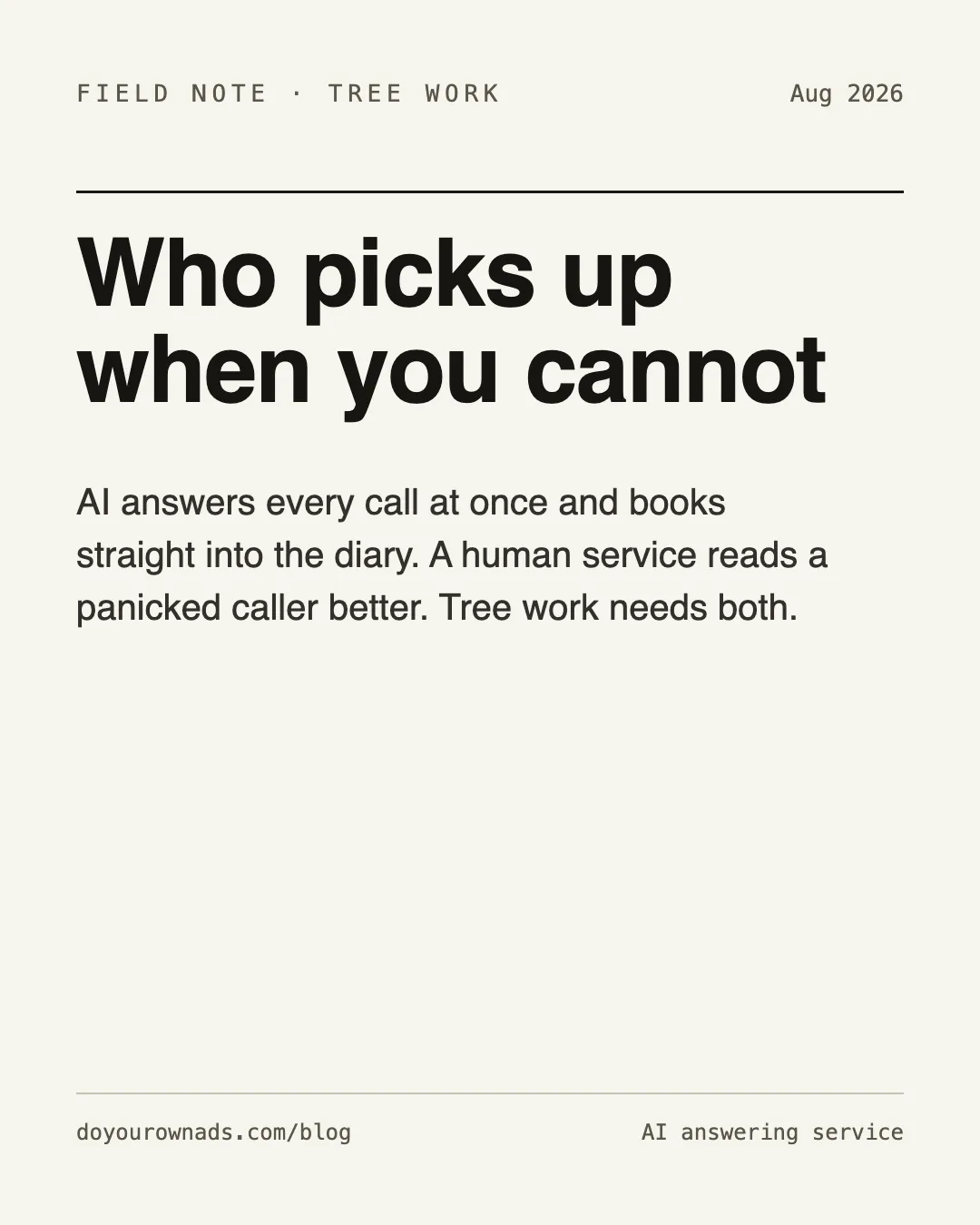
Every product in this category exists because of that one moment. The only disagreement is who should pick up: a person in a call centre, or software. They fail in different places, so it is worth being clear about what each actually does with a tree service call.
For the record, we build one of these, so read the section on where AI is the wrong answer with that in mind. It is there because we would rather you not buy the wrong thing.
What each option really is
Voicemail is not really an option, though most tree services run it as one by default. It moves the work onto the caller at the moment they are least willing to do any. Someone in a garden looking at a limb over their roof is not composing a message.
A human answering service is a call centre that answers in your company name, takes a message and passes it on. Good ones are genuinely good: warm, calm with a distressed caller, able to escalate what you tell them to escalate. What they usually cannot do is know your schedule, your service area boundaries or your pricing, because yours is one script among dozens they run that week.
An AI answering service picks up on the first ring every time, with no queue and no staffing pattern. Give it your service area, job types and calendar and it can do what a message taker cannot: put a real appointment in a real diary while the caller is still on the phone. It is also, today, worse than a good human at the unusual call.
Where a human answering service still wins
Three situations, and they are not small ones.
The first is the emotionally loaded call. A tree on a car, a tree on a roof, a neighbour threatening to sue about a limb. Those callers need someone who hears what they mean rather than what they said. Software is improving at this and is not there.
The second is anything genuinely unusual. Complicated access, a preservation order, a dispute over who owns the tree, an insurance job with a loss adjuster. A script cannot anticipate these and a person can at least take a sensible note.
The third is the business that does not want bookings taken at all. If every enquiry needs your eyes on the tree before a price exists, automatic booking is not the value you are buying. An accurate message is enough.
Where AI wins for tree work specifically
The case for AI here is not that it is cheaper or cleverer. It is that tree work has a coverage problem no human roster fits neatly.
Calls arrive during the working day, when the whole crew including you is physically unable to hold a phone. They also arrive at nine at night after a wind, on Sunday, and in a two hour burst after a storm when every homeowner in the area rings at once. That last one is where a human answering service quietly breaks: a queue forms, and a caller with a broken fence does not wait in a queue when four other tree companies sit in the same search results.
Software has no queue, no shift and no bad afternoon. For a business whose demand is genuinely spiky and weather driven, that is the whole argument.
The second argument is what happens next. A message that lands in an inbox you read at seven in the evening turns a missed call into a delayed callback, which is better but is not a booked job. Booking straight into your calendar removes the step where a lead goes cold in a notes app. We wrote up what a missed call actually costs a tree service separately, and it is the number most owners underestimate.
The question that decides it
Ask this: on a normal Tuesday, how long does a new caller wait before somebody who can actually book them picks up?
If the answer is minutes, you have a coverage problem and answering is the fix, human or AI.
If they get through fine but nothing gets scheduled until you sit down at night, you do not have an answering problem. You have a booking problem, and a message taking service of any kind will not touch it.
If you barely get calls, stop reading about answering services. Your problem is demand, and the fix sits upstream in your Google Business Profile, your reviews, or paid search. We have a breakdown of what a Google Ads account for tree work should look like, and a separate piece on what it actually costs us to generate a tree service lead with the methodology under every number.
What to check before you buy either
Four things decide whether it works.
Does it know your service area? Booking a job ninety minutes outside your radius is worse than missing the call.
Can it book, or only take a message? Ask to see the calendar integration, not a description of it.
What happens to a call it cannot handle? There must be a route to a human. An AI that confidently mishandles an emergency is a liability.
Does it text back the ones it misses? An unanswered call that gets a text within a minute is often recoverable. One that gets nothing is gone.
Before pricing any of it, size the problem with your own numbers. Our free missed call calculator needs three figures and no email address. If the result is small, this category is not your priority. If it is large, our answering and booking system for tree services was built for the coverage gap described above.
FAQ
How much does an AI answering service cost for a tree service? Pricing is usually a monthly fee with a call allowance or a per minute rate, and it varies enough between vendors that any single figure here would mislead you. The comparison that matters is not the fee against a human service, it is the fee against the value of the jobs you currently miss. Work that second number out first.
Can an AI answering service actually book tree jobs into my calendar? Some can, some only take messages, and the marketing language for both is nearly identical. Ask which calendar it writes to, what happens when two callers want the same slot, and whether it checks your service area before offering a time. Vague answers mean it is a message taker.
Is AI answering better than a human answering service? Not universally. AI wins on coverage, speed of pickup and booking straight into a diary. A good human service wins on emotionally difficult calls and anything no script covers. Tree work has plenty of both, which is why sensible setups route the strange calls to a person.
What happens to my calls during a storm? Worth asking every vendor directly, because storm weeks are when a tree company earns a large share of its year. Human services form a queue when volume spikes. Software answers everyone at once and handles the genuinely distressing calls worse. Know which failure you are choosing.
Will callers know they are talking to an AI? Many will. What loses the job is not the caller recognising software, it is software wasting their time or getting details wrong. Being upfront that it is an assistant, and booking them in under a minute, lands better than pretending otherwise.