What It Actually Costs to Generate a Tree Service Lead
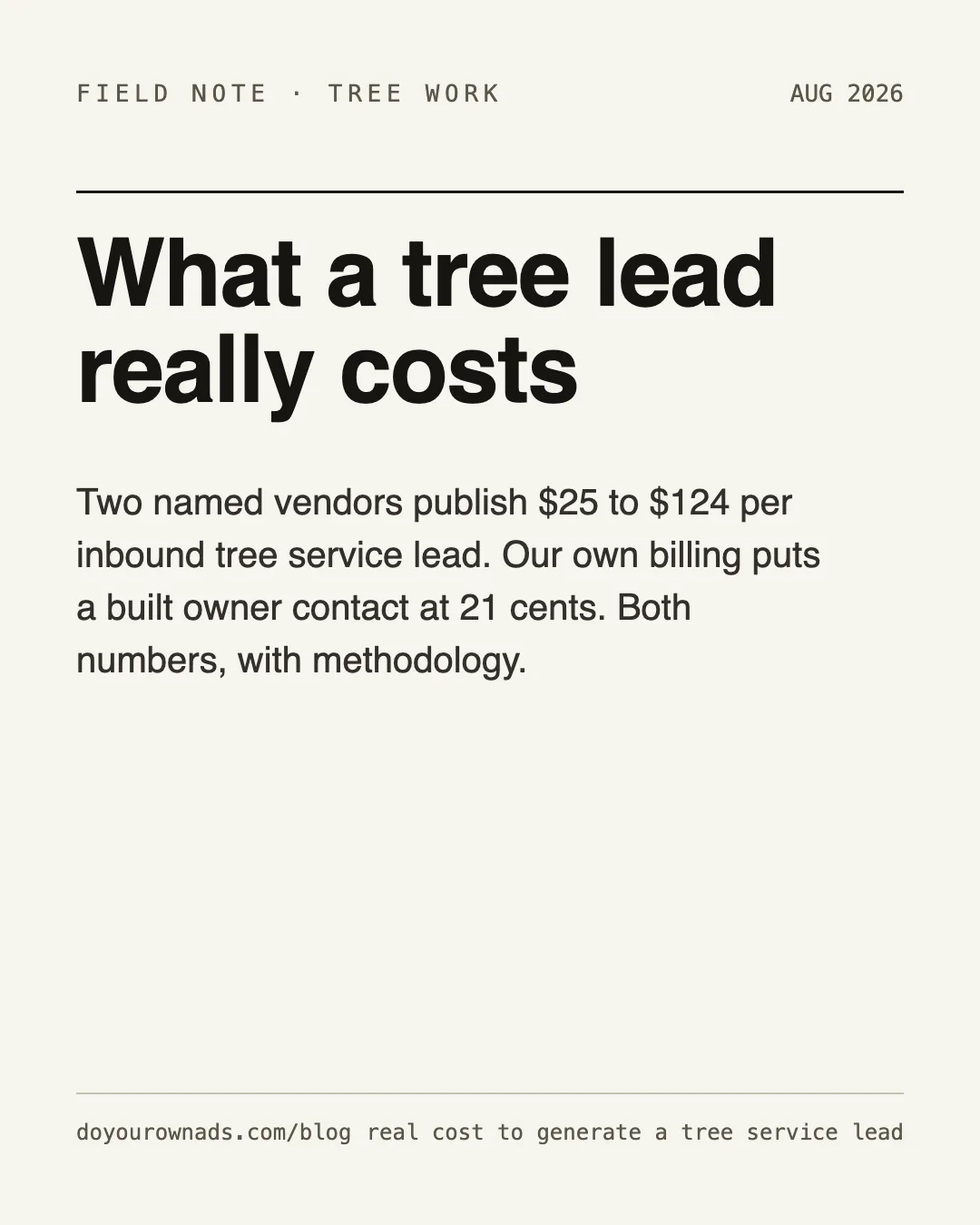
Ask what a tree service lead costs and you get a number with no units attached, because two different things are both called a lead. One is an inbound call from a homeowner with a dead oak who wants a quote this week. The other is a row in a spreadsheet with an owner's name and a working phone number on it. They are worth different amounts and they cost different amounts, so anyone quoting one figure for both is selling something.
Below are real numbers for both. The vendor prices are published prices from named companies, linked so you can check them. The build-it-yourself prices are our own billing, with the sample size stated so you can judge how much weight they deserve.
What buying an inbound lead costs
These are published, public prices, not estimates.
99 Calls lists tree service lead costs on its own page: $33.99 per lead flat rate for organic SEO leads, $46 to $124 per lead as a nationwide average for Google Ads, and $49 to $109 per lead as a nationwide average for Local Services Ads.
Home Service Direct publishes a headline range of $25 to $85 per exclusive lead, then breaks it out by channel: $45 to $85 per lead on Google Ads, $25 to $45 per lead on Facebook and Instagram, and $35 to $75 per call on Local Services Ads.
Two vendors, published independently, and their Google Ads figures overlap in the $45 to $85 band. That overlap is the most useful thing on this page: a tree service budgeting for paid search should expect the high tens of dollars per lead, not five dollars and not five hundred. Local Services Ads land in a similar band in both sets of numbers, which is worth knowing because LSA is often pitched as the cheap option.
None of that is the cost of a job. It is the cost of a conversation. Close rate does the rest of the work, which is why the same lead price produces a profitable channel for one company and a loss for another.
What building a contact list costs
This is the other kind of lead, and the one we can price from our own invoices rather than someone else's marketing page. We build outbound contact lists of tree service owners with a Google Maps scrape followed by enrichment. Measured on a billed pilot of 100 listings and 25 enrichment leads on 2026-08-17:
- Google Maps listing scrape: $5.01 per 1,000 listings. Actual billing was $0.5007 per 100 listings.
- Skip trace for owner name and phone: $0.0552 per lead. Actual billing was $1.38 for 25 leads.
- Cost per usable owner name plus phone: $0.215. That is after discarding partial matches and name artifacts.
Three findings from the same 100 listing sample matter more than the prices. Ninety nine percent of US tree service listings publish a phone number. Eighty four percent publish a real street address. Zero percent publish an email address on the listing. If you are building an email list, the maps scrape alone gives you nothing, and any article telling you to scrape Maps for emails has not tried it.
A second pilot on 2026-08-20 covered 400 listings across four cities and measured what fraction survive to a usable, verified email. Roughly four percent of listings become a sendable row, at about $0.48 marginal cost each. At that rate, 500 to 600 sendable rows means working through roughly 15,000 listings, which came to about $115 all in once search API calls and an email verification pack were included.
The honest comparison
A bought inbound lead costs tens of dollars and arrives wanting a quote. A built outbound contact costs cents and has never heard of you. The ratio between them is roughly one hundred to one, and it is not a discount. It is the price of demand: you are paying the vendor for the fact that the homeowner already decided they need a tree removed.
This is also why the arithmetic that matters is not cost per lead at all. It is cost per booked job. A $60 lead that closes at 40 percent costs $150 per job. A $60 lead that closes at 10 percent costs $600 per job, and the lead price never changed. The variable that moved was what happened after the phone rang, which is almost always answering speed rather than sales skill. We wrote up what an unanswered call costs a tree service separately, and you can run your own numbers with the free missed call calculator rather than taking ours.
Methodology and limits
Every number above is either a published vendor price with a link, or our own measured cost with the sample size named. We have not published an industry average, because we have not measured one.
The limits, stated plainly. Our cost figures come from samples of 100, 25 and 400 rows. That is real billing rather than projection, but they are small samples in four US cities and they will move with geography and vendor pricing. The vendor prices are what those two companies publish today for their own service, not a market survey.
If you would rather not build any of this and would rather have the paid channel built and run for you, that is what our DFY Growth System for tree services is. If the gap you are actually closing is the one after the phone rings, that is the job of our tree service call answering and booking system. If you want to understand the cost structure first and decide later, the numbers above are the whole picture we have.
FAQ
What is a good cost per lead for a tree service? There is no single good number, because it depends on your close rate and average job value. What the published data supports is a range: two named vendors both put Google Ads tree service leads in roughly the $45 to $85 band, with Local Services Ads similar. Judge a channel by cost per booked job.
Why do lead prices vary so much between $25 and $124? Channel and exclusivity. Shared leads sold to several companies at once are cheaper per lead and close far worse, because you are racing other crews to call first. Exclusive leads cost more per lead. Emergency intent searches also cost more than research queries, and storm season moves prices in both directions.
Is it cheaper to buy leads or generate them yourself? Per contact, building is dramatically cheaper: we measure about $0.215 for a usable owner name and phone against tens of dollars for a bought inbound lead. But they are not the same product. A built contact has no intent and needs outreach and follow up to become a conversation. Buying skips that work and you pay for the skip.
Do Google Maps listings contain email addresses for tree services? In our sample of 100 US tree service listings, none did. Ninety nine percent had a phone number and eighty four percent had a street address, but zero published an email on the listing. Email has to come from the company website or a separate source, and then it has to be verified.
How do I calculate my own cost per lead? Take everything you spent on a channel in a month, including agency or software fees, and divide by the number of genuine inquiries it produced. Then divide by your close rate on those inquiries to get cost per booked job. That second number is the one to make decisions on.