What Tree Lead Sellers Actually Sell You
Search for reviews of any tree lead company and you get two kinds of page. One is the company's own marketing. The other is a competing lead company explaining why the first one is bad. Neither is a review, and between them they have crowded out the thing an owner actually wants, which is a straight answer about what the money buys.
Worth saying up front: we sell tree service marketing, so we are one of the interested parties. What follows is checkable rather than flattering, and where we could not check something we say so.
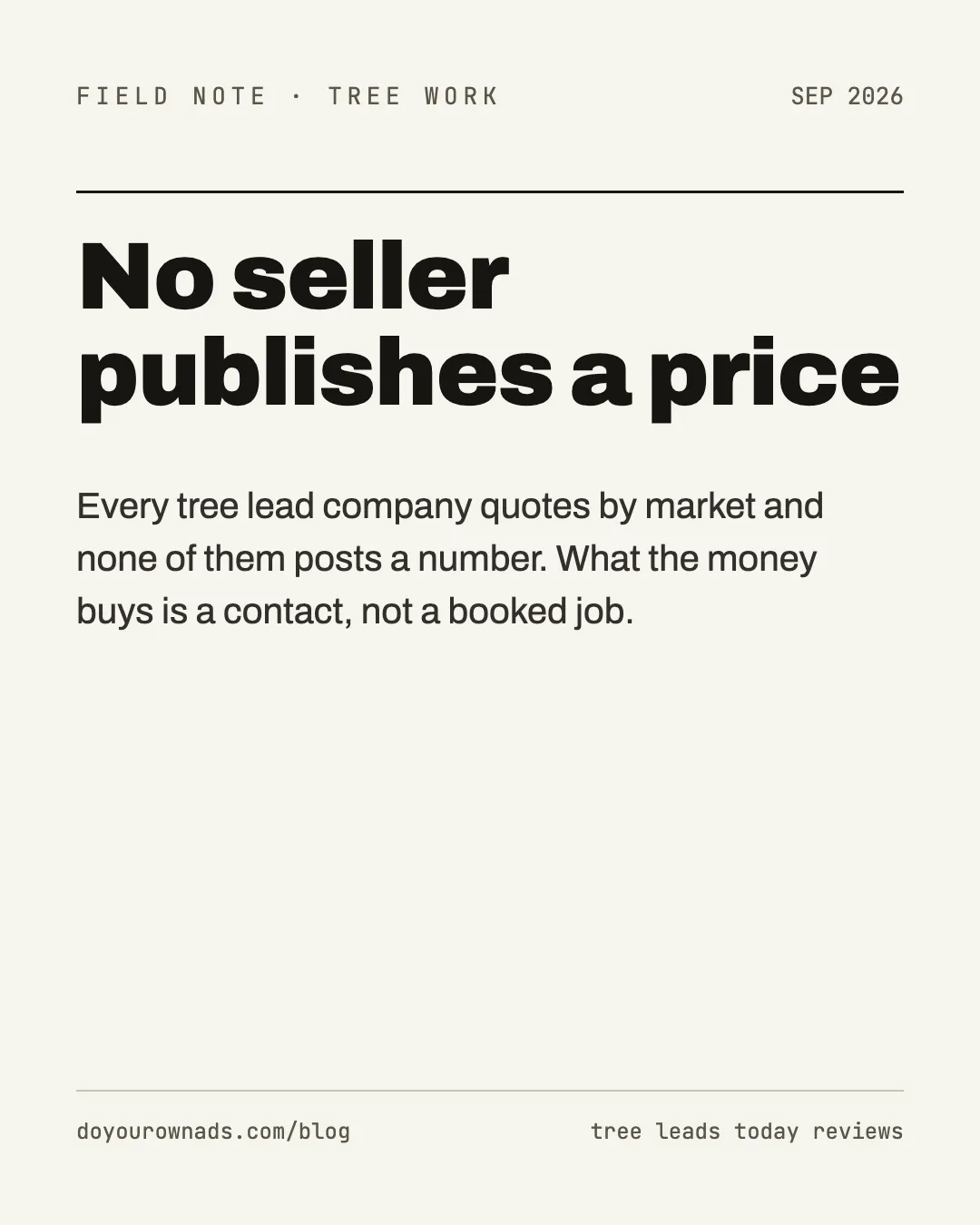
Nobody in this category publishes a price
This is the single most useful fact about shared and pay-per-lead sellers, and it took about ten minutes to establish. On 2026-09-21 we read the public pages of the lead sellers that rank for these searches. None of them states a per-lead price. treeleads.co says it directly: pricing is based on your specific market because advertising costs vary by area. The others simply do not mention a number at all.
The defensible reason for that is that lead costs really do vary by metro. The consequence is that you cannot compare two vendors before a sales call, so the first number you hear will be the one that anchors every number after it.
The per-lead figures that do circulate online mostly sit on competitors' pages, describing a rival's pricing second hand. We are not going to repeat those numbers, because the source in every case is a company that benefits from the number looking high.
The three questions that decide whether a lead is worth buying
Is it exclusive, and for how long? A shared lead is sold to several companies at once, so you are buying a race rather than a customer. Exclusive costs more per lead and is usually worth it, but the word needs a definition in writing. Ask whether it covers this one job or the homeowner for a period.
Who owns the phone number and the record? If calls route through the vendor's tracking number and the contact record lives in their system, you are renting the relationship. When you leave, the history does not come with you.
What counts as a billable lead? This is where most of the disappointment comes from. A vendor billing per call will usually bill a call that rings long enough to connect, which includes wrong numbers, price shoppers outside your service area, and the same homeowner calling twice. Ask for the exact billable definition and ask what the dispute process is.
The maths the marketing does not show you
Vendor calculators tend to run on the vendor's assumptions. The treeleads.co calculator, for example, defaults to a $2,400 average project value and a 50 percent close rate on a bought lead, which is their stated assumption and not a measurement of your business.
Put your own numbers in instead. Take your real average job value, your real close rate on cold inbound work, and be honest that a bought lead closes worse than a referral. The figure that matters is cost per booked job, not cost per lead, and the gap between the two is your close rate. A lead that costs half as much and closes a third as often is the more expensive lead.
Our missed call cost calculator runs the same arithmetic on the leads you already get, which is the comparison most owners have never made. Buying leads while missing calls is paying twice for the same phone call.
Where bought leads genuinely make sense
They are a real tool, not a scam, and the honest use cases are narrow. A new truck with an empty schedule needs volume now and cannot wait a quarter for organic work. A slow season needs filling. A crew moving into a new territory has no reputation there yet. In all three the right frame is that you are renting demand at a known cost while you build something you own.
The failure mode is making them permanent. Rented demand does not compound, the price is set by someone else, and the day you stop paying the pipeline is empty. That is the argument for building your own tree service lead generation alongside anything you buy, rather than instead of it.
If you are weighing bought leads against doing the work yourself, DIY tree service marketing versus hiring an agency sets out the same trade in more detail, and how to price tree removal jobs without guessing covers the close-rate side of the arithmetic above.
FAQ
How much do tree service leads cost? None of the sellers that rank for these searches publishes a price, which we verified by reading their public pages on 2026-09-21. treeleads.co states that pricing depends on your market. Expect the number to come from a sales call, and expect it to vary by metro.
Are shared tree service leads worth it? Sometimes, for a defined stretch: a new crew, a slow season, a new territory. They work badly as a permanent channel, because you are renting demand at a price someone else sets and it stops the day you stop paying.
What is the difference between shared and exclusive leads? A shared lead goes to several companies at once, so speed of response decides who wins it. An exclusive lead goes to you alone. Get the definition of exclusive in writing, including whether it covers the homeowner or only the single job.
Should I buy leads or run my own ads? Compare cost per booked job rather than cost per lead, using your own close rate on cold inbound work. Bought leads usually win on speed to first job and lose over time, because nothing you rent accumulates.
What should I ask a lead vendor before signing? Pin down what counts as billable, how disputes are handled, who owns the tracking number and the contact record, whether the lead is exclusive and for how long, and what happens to your data when you leave.