How to Grow a Tree Service Business
Search this and you mostly get advice about starting a tree service. Get licensed, buy a chipper, find your first customer. Useful once. Useless if you already have a truck, a crew, and a business that has stopped getting bigger.
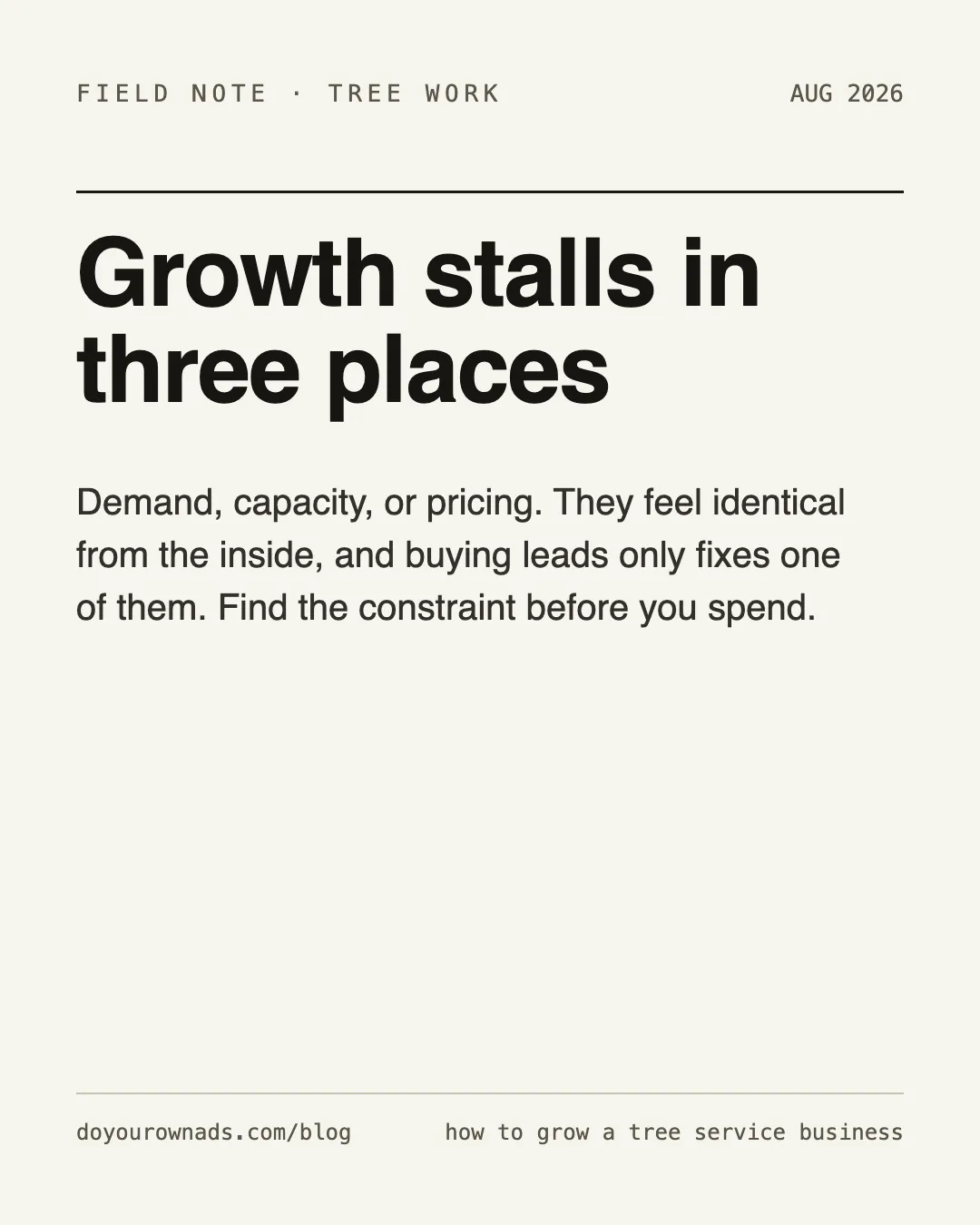
Growth stalls for a small number of reasons and they look identical from the inside. The phone feels slow, or the crew feels busy, or the money feels tight, and the instinct is to go get more leads. Sometimes that is right. Often it makes things worse, because demand poured into the wrong constraint just creates a longer list of people you disappointed. So the first job is not marketing. It is working out which of the three is actually holding you.
Find the constraint before you spend anything
There are only three places a tree service gets stuck.
Demand. The crew has gaps in the week. You could take more work tomorrow if it existed. This is the only case where buying leads is the obvious answer.
Capacity. The schedule is full, you are booked out two or three weeks, and you are turning work away or losing it to whoever can come Thursday. More leads here buy you nothing except a longer backlog and worse reviews.
Cash and pricing. The trucks are moving, the calendar is full, and there is still nothing left at the end of the month. This is the most common one, and it is the only one where the fix costs nothing to implement.
Look at last month honestly: the days a crew sat idle or went home early, the jobs quoted that never came back, and the ones won that you wished you had not. Those three numbers tell you which section below matters.
Pricing is the fastest lever you have
If the calendar is full and the bank account is not, you are underpriced, and no amount of new marketing fixes that. It makes it worse, because you scale a loss.
Most owners price by feel, anchored to what they charged three years ago and what they imagine competitors charge. Neither of those is a cost. Your price has to carry the crew, the truck payment, fuel, insurance, the chipper, dump fees, drive time, and the hours spent quoting jobs you do not win. Quoting is real work and it is almost never in anyone's number.
A useful test: take your last ten completed jobs and work out what each one actually left you after everything, including your own time. If two of them carried the other eight, you do not have a marketing problem. You have a pricing problem wearing a marketing costume.
Raising prices feels like it will cost you work. In practice it usually costs you the jobs you were losing money on, which is not a loss.
Capacity: the ceiling most owners hit second
If you are booked three weeks out and still turning down work, the constraint is people and equipment, not demand.
Hiring in tree work is genuinely hard. A good climber is not an interchangeable hire, and a bad hire on a rope is a different category of risk from a bad hire in an office. That is why so many tree services stall at one crew for years.
What tends to move first is not a new climber. It is taking the work off the owner that does not need an owner. If you are the estimator, scheduler, dispatcher, invoicer and the person answering the phone, your calendar is the company's real ceiling, and it is full of tasks a system or a part-time hire could carry. Buying back your own hours is usually cheaper than a second crew, and it is what makes the second crew possible later.
Demand: only after the first two
If you genuinely have gaps in the schedule, then go get work, in roughly this order.
Your Google Business Profile, because map pack results are where local emergency searches land, and it costs nothing but attention. Photos of real jobs, correct service area, steady reviews.
Reviews, deliberately and every week rather than whenever you remember. Almost nobody does this consistently, which is exactly why it works.
Repeat and referral work, the cheapest demand there is. Most tree services never contact a past customer again, and a homeowner with one dead oak usually has more trees and neighbours with the same problem.
Paid ads, once the three above are running. Paid search is the fastest way to turn money into booked jobs, and also the fastest way to turn money into nothing if the account is set up badly. We wrote up the Google Ads mistakes that burn tree service budgets separately, because those five errors account for most of the waste we see.
The leak that sits under all three
Every section above assumes that when the phone rings, someone answers it.
Tree work has a structural problem here that most trades do not. The owner is frequently thirty feet up a tree or running a saw, which are the two situations in which a phone cannot be answered. The calls arrive mid-workday, from homeowners often ringing several companies in a row, and the first firm to put a human on the line very often gets the job.
This makes an unanswered call different from a lost lead. You already paid for it, in ad spend or in the years of reputation that made them call you. Our free missed call calculator works out what yours are costing, and it needs three numbers and no email address. If the figure is uncomfortable, our answering and booking system for tree services is built for exactly this, and if you would rather have the demand side run for you as well, that is the done-for-you growth system.
What to do first
Pick the constraint, not the tactic. If the money is thin and the calendar is full, reprice. If the calendar is full and the money is fine, buy back your own hours before you buy a truck. If there are gaps in the week, fix the profile and the reviews before you spend on ads. And in all three cases, make sure the phone gets answered, because every other improvement on this page runs through it.
FAQ
How profitable is a tree service business? It varies too much by market, crew size and job mix for a single honest number, and anyone quoting you one has not seen your costs. What is consistent is where the profit hides: pricing that carries drive time, quoting time and equipment rather than just the hours on site. Work out the margin on your last ten jobs before trusting any industry average.
How do I get more tree service jobs without spending money? Reviews and repeat customers, in that order. Ask every satisfied customer for a Google review the day the job finishes, and contact past customers before storm season. Both are free, both compound, and both are neglected by most competitors in your area.
Should I hire another crew or buy more equipment first? Usually neither. If you are the bottleneck, the cheapest capacity available is taking the office work off yourself: a second crew you cannot schedule, quote or invoice for does not produce a second crew's revenue.
Is it worth buying tree service leads? Only if your constraint is genuinely demand. Bought leads poured into a full schedule create backlog and bad reviews rather than growth. If you do have gaps, judge any lead source on cost per booked job rather than cost per lead, because close rate matters more than lead price.
Why do I lose jobs after quoting them? Speed is usually the reason rather than price. Homeowners ringing about a tree tend to ring several companies, and whoever answers and quotes first often wins before the rest reply. Track your response time on new enquiries before assuming you were too expensive.