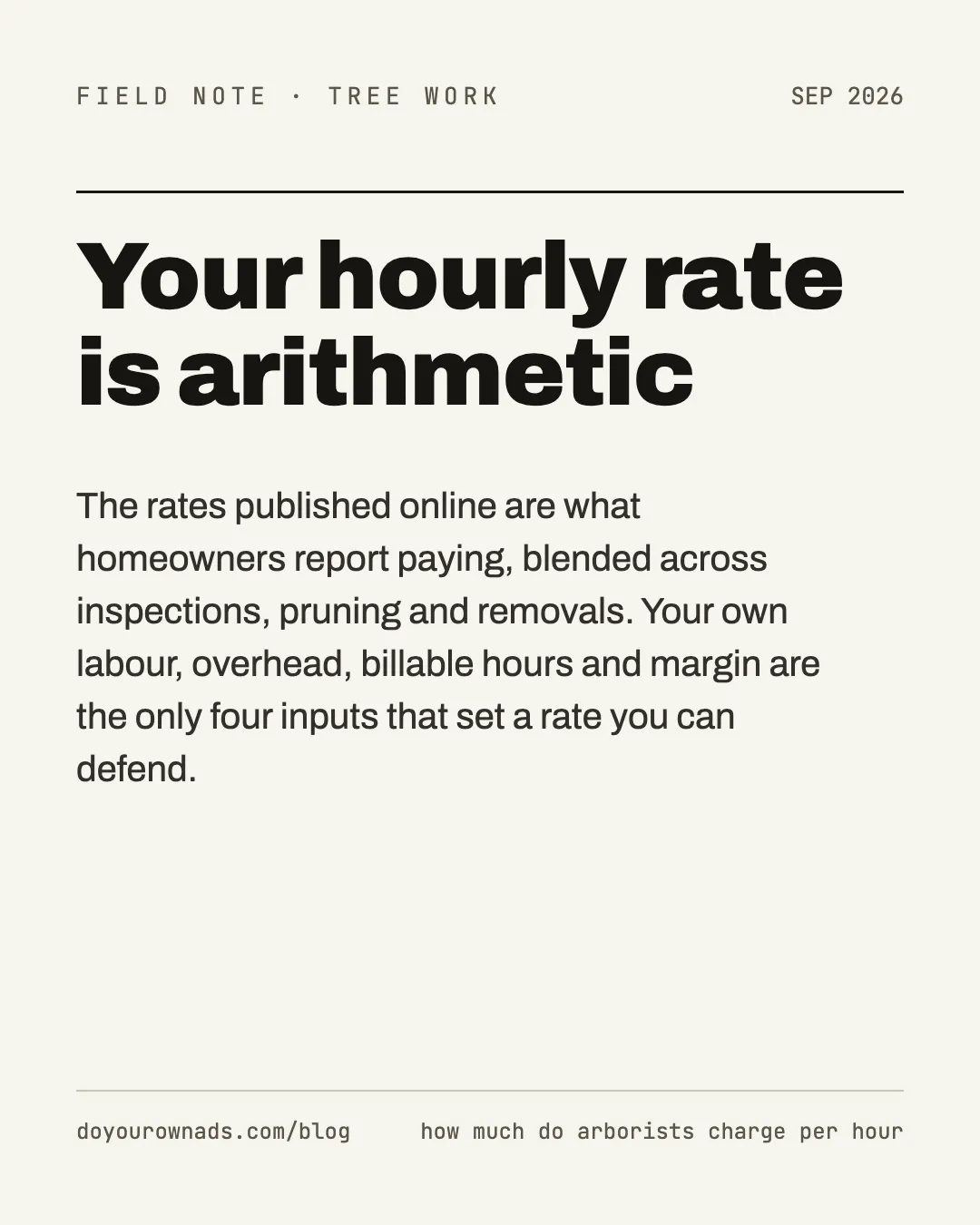
What Arborists Charge Per Hour and How to Set Your Rate
Search this and you get two conversations stacked on top of each other. The first five results are written for homeowners and answer "what will this cost me". Further down, an r/arborists thread asks whether $100 an hour per person is reasonable, and a Facebook group asks what a certified arborist charges per day in Houston. Those are owners asking each other, and nobody has written the answer down properly.
Disclosure first: we sell marketing to tree services. The pricing sections below have nothing to sell.
The published rates are consumer research, not a benchmark
The cost pages that rank for this query aggregate what homeowners report paying. That is useful if you are buying tree work and close to useless if you are selling it.
A reported price carries no information about the crew that earned it. A rate that keeps one climber and a groundman profitable in rural Ohio will quietly bankrupt a three-person crew with a chipper payment in Seattle. The figure also blends inspections, pruning and removals into one number, and those three jobs have nothing in common on the cost side. Copying a national average is how owners end up busy and broke, so the rate has to come from your own books.
Build the rate from the bottom
Four inputs, and you already own all of them. Pull them from last year's records rather than estimating, because the estimate is always kind to you.
Your true labour cost per person, per hour. Not the wage. The wage plus payroll taxes, workers compensation and any benefits. Workers comp for tree work is the line that surprises people, and it belongs inside the rate rather than in a mental note.
Your overhead per year. Insurance, truck and chipper payments, fuel, maintenance, saws and ropes, licensing, phone, software, the accountant. Everything you pay whether or not you work Tuesday.
Your genuinely billable hours per year. This is the input everyone inflates. Drive time, quoting, dump runs, equipment repair, weather days and the afternoon you spent on the phone are not billable. Owners who track this honestly usually find the figure is far lower than the hours they work.
The margin you intend to keep. Decide it on purpose. Leaving it to whatever is left over is the same as setting it to zero.
Then the arithmetic is one line:
Hourly rate = (labour cost per hour + (annual overhead ÷ billable hours)) ÷ (1 − margin)
A worked example, with every assumption stated
These four numbers are ours, invented to show the mechanics. They are not a benchmark and they are not research. Replace all four before you price anything.
Take a two-person crew with fully loaded labour of $38 per person per hour, so $76 for the crew. Annual overhead is $60,000. Billable crew hours come to 1,200 in the year, roughly 24 hours a week across 50 weeks, which is deliberately conservative. The target margin is 20 percent.
Overhead per billable hour is $60,000 ÷ 1,200, which is $50. Add the $76 of labour and the crew costs $126 an hour before profit. Divide by 0.8 and the rate is $157.50 per crew hour, or about $79 per person per hour.
Now change one input. Hold everything else and drop billable hours from 1,200 to 900, which is what happens after a wet spring. Overhead per hour becomes $66.67, the cost becomes $142.67, and the rate has to move to $178 per crew hour to keep the same 20 percent. A quarter of your billable time disappeared and the rate had to rise by 13 percent. That sensitivity is the real lesson, and it is why the next section matters more than the formula.
Billable hours are a marketing number
Most owners treat the billable-hour input as fixed by the weather and the season. It is not. Every hour of capacity you fail to sell raises the rate every other hour has to carry.
The cheapest hours to recover are the ones lost to the phone. A crew running a saw does not answer it, the homeowner calls the next company on the list, and the job never appears in your books as a loss because it never appeared at all. The missed call cost calculator runs that arithmetic on your own job value and call volume, and the companion piece on what missed calls actually cost a tree service walks through where the leak appears.
The structural fix is making sure the phone gets answered while the crew is off the ground, which is what our tree service answering and booking setup is built to do. Recovering 150 billable hours in the example above moves the required rate down by about $15 per crew hour, which reads to a customer as competitive and reads on your side as the same margin.
Raising it
Rates move when the inputs move, and the inputs move every year. Insurance renews higher, a truck comes off warranty, a climber earns more. Reprice annually against your own books rather than a competitor's yard sign, because you cannot see their overhead and they may be getting it wrong.
Quote the job rather than the hour once you can estimate reliably, since customers compare hourly rates against each other and compare job prices against the tree. And do not discount to win volume before you know your number, because volume at a rate below cost only speeds up the loss.
If the honest answer is that you have capacity you cannot fill at a defensible rate, that is a demand problem rather than a pricing one. Starting a tree service: what owners learn in year one covers where the first jobs come from, and DIY tree service marketing versus hiring an agency is the honest comparison of doing it yourself against paying someone. When the constraint is genuinely lead volume rather than pricing, our done-for-you Google Ads management is the lane built for that.
FAQ
How much do arborists charge per hour? There is no national figure worth pricing against. The consumer cost pages that rank for this question are reporting what homeowners say they paid, blended across inspections, pruning and removals, and across crews with completely different cost structures. Your defensible rate comes from your own labour cost, your overhead, your billable hours and the margin you choose to keep.
Why is a certified arborist more expensive than a general tree service? Certification carries costs that sit inside the rate: the credential, the continuing education to keep it, and usually a higher wage for the person holding it. It also changes what the visit is for, since a consulting arborist sells an assessment rather than a removal.
Should I charge by the hour or by the job? By the job, once your estimates are reliable. Hourly billing invites the customer to compare you against another company's hourly number, which tells them nothing about how fast either crew works. Job pricing is judged against the tree instead. Keep calculating your hourly rate internally, because it is what tells you whether a job price is any good.
What is the most common pricing mistake? Overstating billable hours. Drive time, quoting, dump runs, repairs and weather days are real hours that are not billable, and counting them spreads overhead across hours that never get invoiced. That produces a rate that looks profitable on the spreadsheet and is not.
How often should I change my rate? Once a year against your own numbers, plus immediately after any step change in a fixed cost such as an insurance renewal or a new truck payment. Waiting until the margin is visibly gone means working a full season at the old rate.